


|
|
|
|
|
|
|
|
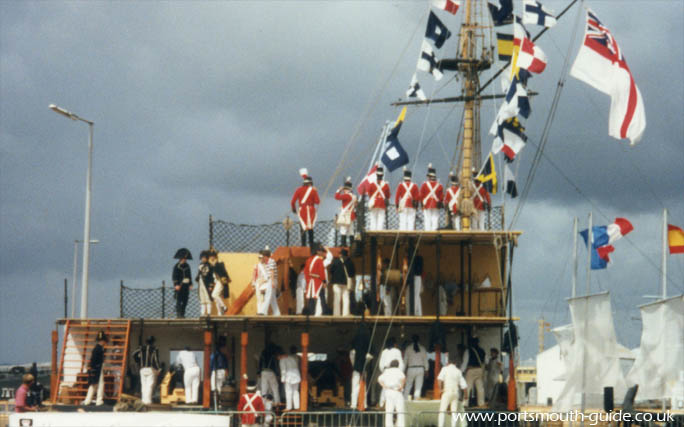
Portsmouth Historic dockyard is home to the Royal Naval Museum, HMS Victory, HMS Warrior and the Mary Rose. In addition to these permanent attractions there are frequently other attractions in the dockyard. The above photograph shows 1805 Live which was a reenactment of the battle of Trafalgar. This was presented alongside HMS Victory which was an ideal setting for it. This was part of the Dockyard Festival of 1996, there was also an opportunity to visit many parts of the dockyard usually unseen by the public. From 1979 to 1801 the Admiralty purchased 100,000 blocks on average per year and a Blockmakers' contract was worth about £34,000. The Blockmills situated inside the naval base were built by Brunel and in 1801 Brunel took out Patents for some machinery. At the time there was machinery such as treadle lathes and saws, mostly worked by water or horse power was used for manufacturing ship parts. The old engine house, seems to have been demolished and the South Block of the Blockmills built in 1800 together with the North block. It took Maudslay and Brunel until October 1803 to manufacture and install enough machines to begin production in the Blockmills, it was not until 1808 that the 45 machines were all finally completed. Production started with the large sets of machines running out each day 36 blocks, with 10-inch shivers, including a fair percentage of 2-shiver blocks, and the small sets 500 seven inch block a day. At maximum production 140,000 blocks were produced a year. In 1964 there were still 21 machines for preparing shells, 16 for preparing sheaves and 8 other machines left from Brunels originals. Using machines greatly increased the number of blocks produced a year and decreased the cost of the blocks. Much more information about Brunels Blockmills can be found in "Brunels's Blockmills" by Robert Sutherland Horne, L.R.I.B.A., H.M. Dockyard, Portsmouth which can be purchased for the Portsmouth Royal Dockyard Historic Society. Under Portsmouth Dockyard there is a large amount of tunnels used to fill and empty the dry docks, they are still used for this purpose today. They have been featured on lately, when a presenter ventured into the tunnels and explored. A couple of web sites that might be worth checking out are the site and the site. For details about prices and opening times please refer to the flagship site. Both sites are well worth a visit, on the mary rose site there is a movie which gives a computer reconstruction of the ship, this is worth downloading but if you are paying the phone bill I would advise against it as it is just over 4mb. In 1495 Portsmouth got the first dry dock in the country. In 1850 Portsmouth Dockyard covered a 99 acre site and the Historic Dockyard and Naval Base now occupy 300 acres of space. The gate into the Historic Dockyard 'Victory Gate' was completed in 1711, the mast pond which is between boathouse 7, 6 and the mary rose exhibition was excavated in 1665 by soldiers, townsfolk and Dutch prisoners of war. The pond is linked to the harbour by a tunnel under the road. The Storehouses were built in the 1760s to house the stores and equipment for the ships. The clock tower on the top was completed in 1992 and is a replica which was destroyed during 1941. The Naval Academy was completed in 1733 and housed 40 students. From 1906 to 1941 it was the Royal Naval School of Navigation. An event which has been held is The Festival Of The Sea 1998 which was held during the summer of 1998. |
Site Maintainer J Lacey